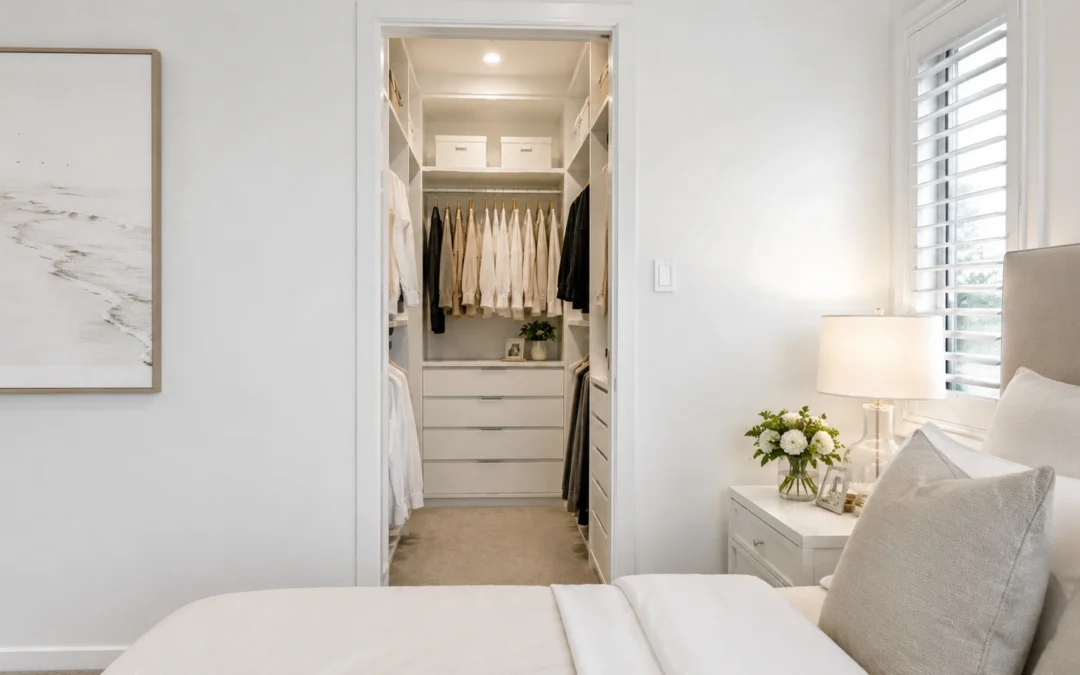
When you invest in a wardrobe built around your room’s exact dimensions and your daily routine, you get more than extra storage — you get a space that genuinely works for you. Custom wardrobe design ideas tailored to your space combine smart layouts, quality materials, and personal preferences to solve storage problems that off-the-shelf furniture simply cannot address.
Key Takeaways
- Floor-to-ceiling designs maximise vertical space and create a clean, architectural finish in any bedroom.
- Sliding door wardrobes hold the largest global market share, making them a proven and practical choice for most Australian homes.
- Sustainable materials such as walnut, ash, and oak are replacing cold, glossy finishes as the dominant aesthetic in 2026.
- Smart technology including motion sensor lighting, app-controlled systems, and digital locks is now accessible for residential wardrobes.
- Integrated vanity and storage combinations are among the most requested features in compact Australian homes.
- Defining who uses the wardrobe and what gets stored inside is the most important step before selecting finishes or fixtures.
Why Tailored Wardrobe Design Outperforms Off-the-Shelf Solutions
Flat-pack wardrobes come in fixed sizes, limited configurations, and standard finishes that rarely match the specific dimensions of your room. A built-in or fully custom wardrobe, by contrast, fills every centimetre from wall to wall, floor to ceiling, and works around architectural features like sloped ceilings, alcoves, or awkward corners.
According to Houzz Australia’s renovation research, storage upgrades consistently rank among the top three motivations for bedroom renovations across the country. Australians in particular are working with increasingly compact homes in urban centres like Sydney, Melbourne, and Brisbane, where every square metre has real financial value.
When you explore options for wardrobes with a professional designer, the conversation starts with function, not aesthetics. The right questions include: who uses this space, how much hanging length do you need, how many shoes do you own, and do you want drawer storage or open shelving? That foundation determines every decision that follows.
Dominant Layout Trends Shaping 2026 Wardrobe Design
Floor-to-Ceiling Configurations
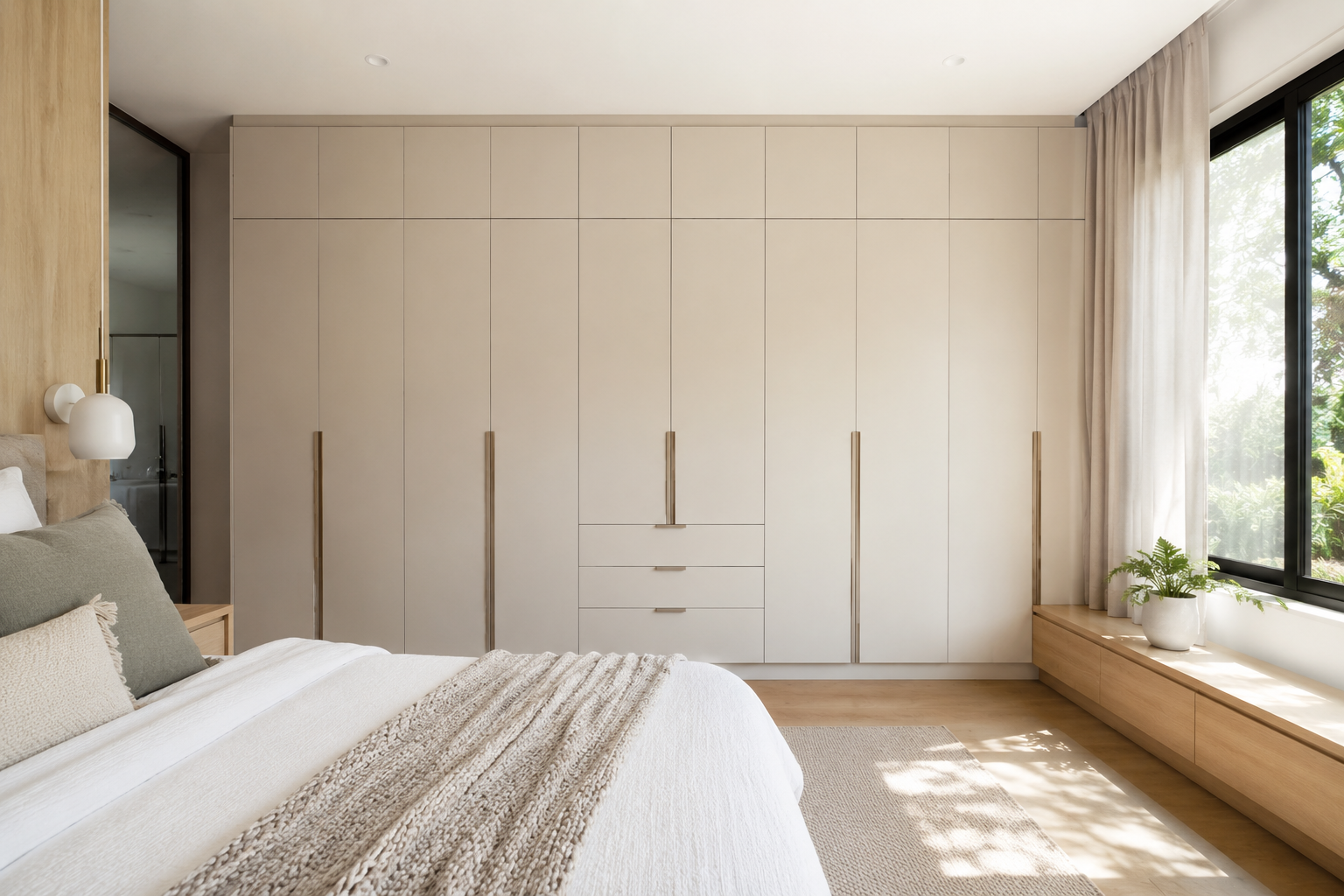
Full-height wardrobes remain the strongest design trend heading into 2026. By extending storage all the way to the ceiling, you eliminate the dead space above standard-height cabinets and give the room a coherent, architectural quality. This works particularly well in modern Australian homes where open-plan living has pushed clean lines into every room, including the bedroom.
If you are renovating a master bedroom, reviewing current bedroom wardrobe design ideas will show just how dramatically a floor-to-ceiling configuration transforms the overall feel of the space.
Sliding Doors Versus Hinged Doors
Sliding door wardrobes currently account for 31.26% of the global wardrobe market share, and the trend is projected to grow at 8.5% annually through to 2034. In Australian homes where bedrooms often lack the clearance for outward-swinging doors, sliding panels are a practical default.
Hinged doors, however, allow you to see the full interior at a glance without panels overlapping sections of the wardrobe. Your choice should come down to the available floor space in front of the wardrobe, not just aesthetics.
Integrated Vanity and Wardrobe Zones
Combining a vanity area within a wardrobe fit-out is one of the most requested features in compact homes. A dedicated section with a mirror, internal lighting, and a small countertop eliminates the need for a separate dressing table, freeing up floor space elsewhere in the bedroom.
Materials and Finishes: What Is Trending in Australian Homes
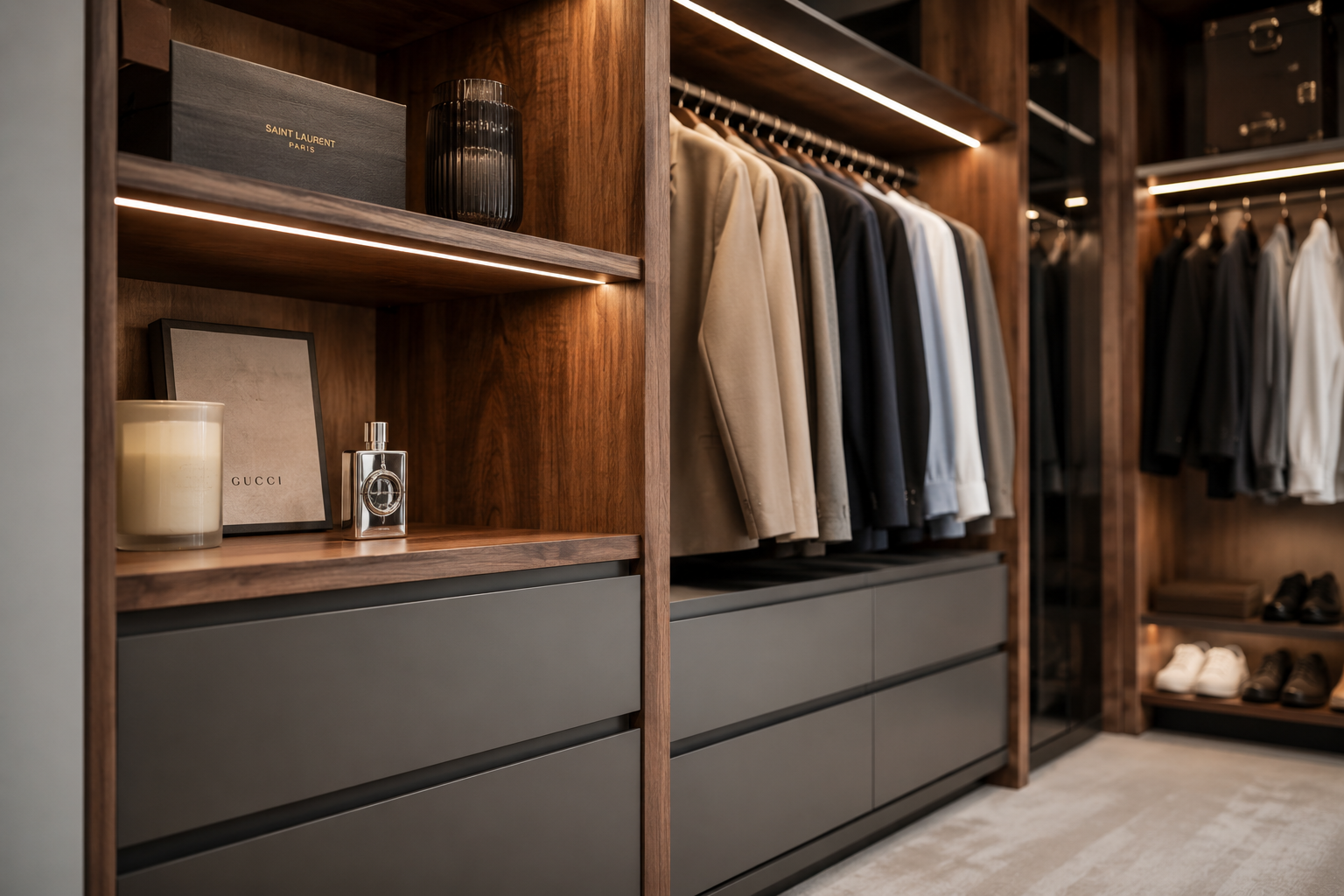
After years of high-gloss white dominating the local market, Australian homeowners are moving back towards warmth. Walnut, ash, and oak veneer finishes are appearing in nearly every contemporary wardrobe design project. These natural tones work well against both white walls and deeper paint colours, adding texture without overwhelming the room.
Matte finishes on cabinet doors and drawer fronts are replacing gloss for a quieter, more sophisticated look. Handleless designs using push-to-open mechanisms or recessed rails are also gaining popularity, keeping the facade clean and reducing visual noise.
From a sustainability standpoint, the shift matters. The Australian Competition and Consumer Commission (ACCC) has noted growing consumer scrutiny of environmental claims in home furnishing products. Choosing suppliers who can demonstrate certified sustainable timber or low-emission board products is now a legitimate part of the buying decision.
For a detailed breakdown of pricing and material options, the resource on built in wardrobe designs costs trends covers current figures for Australian homeowners.
Smart Technology Integration in Modern Wardrobes
Technology has moved from the lounge room into the wardrobe. Motion sensor lighting that activates when you open the doors is now a standard inclusion in mid-range and premium fit-outs. More advanced systems include app-controlled LED lighting that lets you adjust colour temperature, automated lift-down hanging rods for high-mounted rails, and dehumidifier integration to protect clothing in humid climates like Queensland and coastal New South Wales.
Digital locks for jewellery drawers or a dedicated valuables compartment are also appearing in residential wardrobes, a feature previously found only in commercial fit-outs. According to ABC News reporting on smart home trends in Australia, home automation adoption among Australian households has accelerated steadily, and wardrobe technology is a logical extension of that shift.
If you are weighing up the value of these additions, the guide on how to choose the right wardrobe designer includes practical advice on matching your technology preferences with the right supplier.
Space Optimisation Strategies for Challenging Rooms
Not every bedroom is a rectangle with four clean walls. Sloped ceilings in attic conversions, alcoves beside chimneys, and irregular wall angles in older homes all create storage challenges that custom solutions handle well. A designer can build a wardrobe that follows a ceiling pitch exactly, making use of space that would otherwise be wasted.
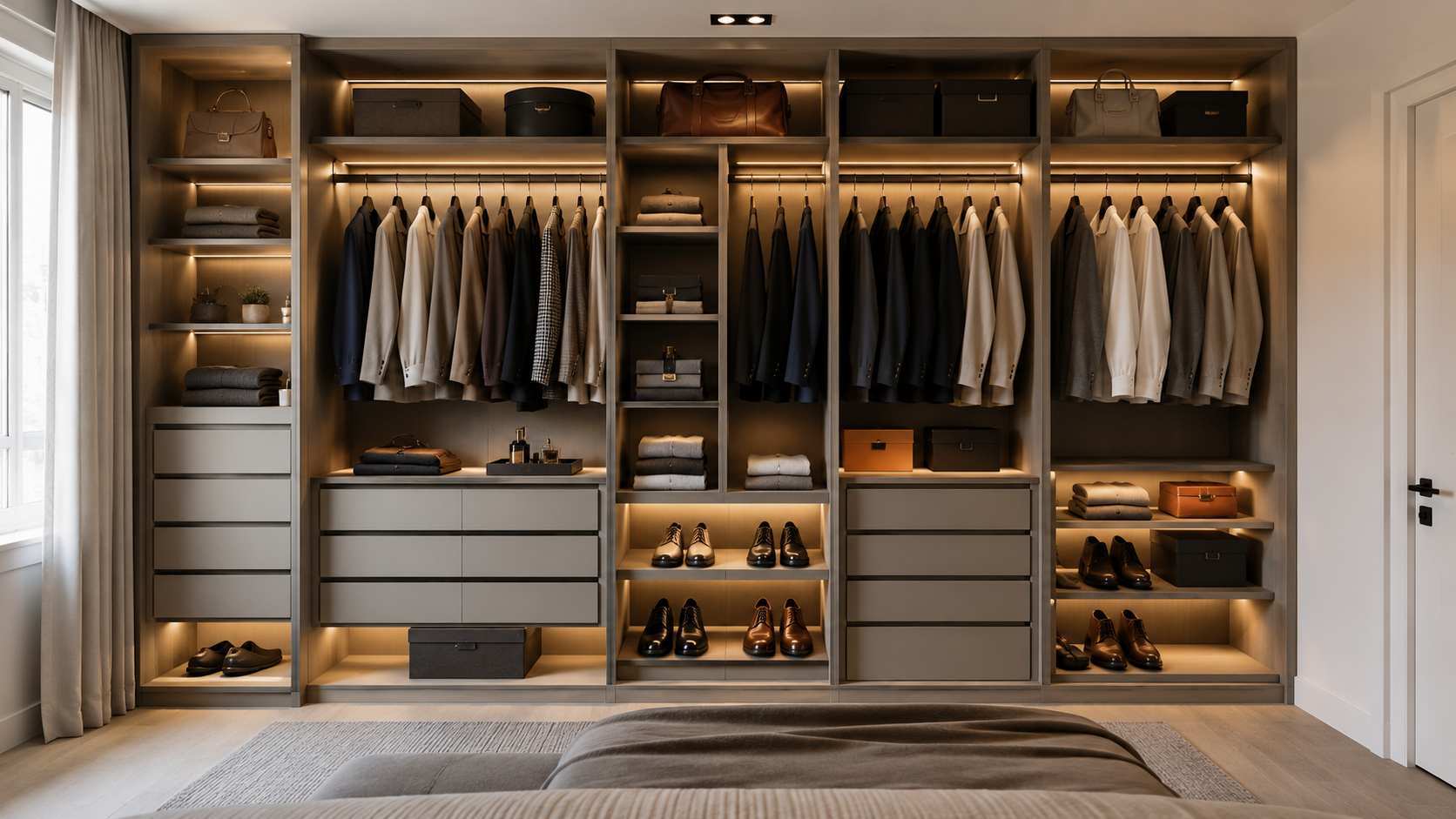
Exploring custom wardrobes with a specialist also means you can address very specific storage needs — double hanging for shirts and jackets, deeper drawers for folded knitwear, pull-out trouser racks, and dedicated shoe storage with adjustable shelf heights.
| Feature | Standard Flat-Pack | Custom Built-In |
|---|---|---|
| Sizing flexibility | Fixed standard widths | Made to exact room dimensions |
| Material choice | Limited options | Full material and finish selection |
| Structural integration | Freestanding | Fixed, built into the room |
| Technology add-ons | Not available | Lighting, sensors, locks |
| Lifespan estimate | 5-10 years | 15-25+ years |
| Resale value impact | Minimal | Moderate to significant |
Things to Know
- Australian building regulations in some states require council approval for wardrobes that alter the structural elements of a room, so check with your local council before starting.
- Measuring twice is critical: even a few millimetres of error affects whether doors sit flush or whether drawers clear the floor correctly.
- Internal organisation accessories such as pull-out baskets, tie racks, and valet rods can often be added after installation if your budget is tight at the outset.
- Ventilation matters in built-in wardrobes, particularly in humid climates. Louvred panels or gaps at the base of doors help prevent musty odours.
- The Australian Bureau of Statistics household data confirms that average household sizes are shrinking, making efficient per-person storage solutions more important than ever.
The Bottom Line on Custom Wardrobe Design Ideas Tailored to Your Space
Getting wardrobe storage right requires more thought than choosing a colour or a door style. The best outcomes come from starting with a clear picture of how you use the space, what you need to store, and how the room’s dimensions can be used to their full potential. From there, every design decision, whether it is a floor-to-ceiling layout, a sustainable timber finish, or a smart lighting system, follows naturally.
Take the time to review current design options, visit showrooms, and consult a professional who works specifically in fitted furniture. The investment pays off in a wardrobe that fits your life precisely rather than forcing you to adapt your routine around it.
Frequently Asked Questions
Q: How much does a custom wardrobe cost in Australia?
Custom wardrobes in Australia typically range from A$1,500 for basic built-ins to A$20,000 or more for full walk-in configurations with premium finishes.
The final price depends on size, materials, door style, and any technology inclusions. Getting three quotes from local suppliers is the best way to establish a realistic budget for your specific space.
Q: What is the best wardrobe layout for a small bedroom?
A floor-to-ceiling sliding door wardrobe along one full wall is the most space-efficient layout for a small bedroom.
This approach avoids using floor space for door swing clearance and maximises vertical storage. Built-in designs also reduce visual bulk compared to freestanding furniture.
.
Q: How long does it take to have a custom wardrobe installed?
Most custom wardrobe installations in Australia take between one and three days depending on the complexity and size of the fit-out.
The design and manufacturing lead time is typically four to eight weeks from the date of your final approval. Planning ahead is important if you are working around a renovation timeline.
Q: Are built-in wardrobes worth it for resale value?
Yes, built-in wardrobes consistently add perceived and actual value to a property, particularly in competitive markets in Melbourne.
Real estate agents across Australia regularly cite storage as a key buyer concern. A well-designed wardrobe can differentiate a property and support a higher asking price.
Q: What materials are most durable for a custom wardrobe?
Moisture-resistant MDF with a hardwood veneer or solid timber components offers the best combination of durability, aesthetics, and longevity.
High-gloss finishes can show scratches more readily over time. Matte laminates and natural timber veneers tend to age more gracefully and require less maintenance.